
REVIEW · STOCKHOLM
Beautiful Stockholm Small Group Walking Tour
Royal power, politics, and cobblestones in 1h45. This small-group route strings together the Opera, parliament, bridges, and Gamla Stan so you can read Sweden’s story directly off the buildings.
I love the small group pace, enough to pause for photos at the key viewpoint spots without feeling rushed. I also love the architecture-led storytelling, with explanations tied to real events like the Bloodbath of Stockholm and the Nobel banquet at City Hall.
One possible drawback: you get short, efficient stop times. It is a great overview, not a long interior visit tour, so if you want hours inside major museums or palaces, you’ll likely want to add time on your own.
In This Review
- Key takeaways before you go
- A compact route with big payoff for Stockholm first-timers
- Meeting at Gustav Adolfs torg and ending by Karl XII
- Royal Swedish Opera: where the royal story starts in Baroque style
- What to watch for
- Riksdagshuset: a visible timeline of voting rights and the king’s role
- The possible drawback
- Riksbron bridge views: government, nobility, and the Nobel banquet connection
- Lejonbacken: the photo stop by the Royal Palace, plus Karl XII and the Grand Hotel
- A practical tip
- Slottsbacken and the Palace Chapel: a short interior moment
- Stortorget: the square where Stockholm’s violence and Nobel fame overlap
- Gamla Stan walking segment: Köpmangatan since 1350 and Skeppsbron at the waterfront
- Price and logistics: is $106.42 good value for this route?
- What kind of traveler this suits best
- Should you book this small group walk?
- FAQ
- How long is the Stockholm walking tour?
- Is the tour offered in English?
- What is the group size?
- Where does the tour start?
- Where does the tour end?
- Are there admission tickets required for the stops?
- Do I need a mobile ticket?
- Is the tour physically demanding?
- When will I receive confirmation?
- What is the cancellation policy?
Key takeaways before you go
- Max 10 people means you get a more personal, conversational walk instead of a herd.
- English-speaking guide with visual explanations helps you understand what you are seeing fast.
- Free admission is listed for every stop on the route, so you can budget for food and transit instead of entry fees.
- Photo-heavy viewpoints like Lejonbacken and the Riksbron bridge make the walk worth it even for non-history nerds.
- Ends by Kungsträdgården, with an easy tram hop toward Djurgården for major museums.
Stockholm is a big menu. Here is what else we tried
- Stockholm: City Archipelago Sightseeing Cruise with Guide★ 4.3 · 10,798 reviews
- Stockholm: Skansen Open-Air Museum Admission Ticket★ 4.5 · 3,427 reviews
- Stockholm: Archipelago Boat Tour★ 4.4 · 3,110 reviews
- Stockholm: Highlights Boat Tour★ 4.3 · 2,542 reviews
A compact route with big payoff for Stockholm first-timers
Stockholm can feel like it has two faces. One is royal and governmental, built for ceremony and power. The other is medieval streets, markets, and waterfront cargo life. This tour gives you both faces in about 1 hour 45 minutes, walking a tight loop from royal landmarks into Old Town.
At $106.42 per person, you are paying for two things more than the walking itself: context and direction. The route is designed so you do not just pass impressive buildings, you learn what each one signals. With a maximum group size of 10, the guide can keep the pace practical and still explain what matters.
The route also stays grounded in real places you can keep using after the tour. When you finish near Kungsträdgården, you are positioned to keep exploring, not stuck far from transit. And since the tour is marked as near public transportation, getting there and continuing your day is usually straightforward.
Meeting at Gustav Adolfs torg and ending by Karl XII
You start at Gustav Adolfs torg, 111 52 Stockholm. It is a good staging spot because it puts you on the eastern edge of the royal and political core, with plenty of surrounding sites to connect in your mind as you walk.
The tour ends at the Karl XII Statue area (Karl XII:s torg 9, 111 47), finishing at the southern end of Kungsträdgården. That matters because Kungsträdgården is a natural launch point. If you want to extend the day, you can take the tram to Djurgården, the museum island. From there you can reach major stops like Vasa Museum, Viking Museum, ABBA museum, and Skansen, depending on what you are most in the mood for.
One small practical note: Stockholm weather can change quickly. One of the write-ups called out a very windy day, which is your reminder to bring a wind layer. If you dress for wind and cool air, the walk stays comfortable.
Royal Swedish Opera: where the royal story starts in Baroque style
Stop 1 begins at the Royal Swedish Opera, paired with a quick orientation on Sweden and Stockholm. You get a sense that a lot of what you see next is connected to royalty, because the formal name of Sweden is Kingdom of Sweden.
From this square, you see a Baroque-style focus: the Royal Palace is described as being built in the early 18th century in the magnificent Baroque style. Even if you are not going inside, seeing how grand and intentional the architecture is helps you understand why Stockholm looks the way it does.
You also get a cultural hook. The Opera house is mentioned in the opera The Masked Ball by Giuseppe Verdi, specifically tied to Swedish King Gustav III. That kind of connection is surprisingly useful. It gives you a mental shortcut: when you see the Opera, you remember not just a building, but an idea of Sweden’s royal drama in art.
On the opposite side of the square, you also learn about another classic-style building, now the Ministry of Foreign Affairs, which used to be the Heir Presumptive palace. In other words, even administrative power has royal roots here.
What to watch for
Look at how the square frames the Royal Palace and how the surrounding buildings keep that “power square” feeling. This stop is marked with about 15 minutes and admission ticket free.
More Swedish streets covered on foot
Riksdagshuset: a visible timeline of voting rights and the king’s role
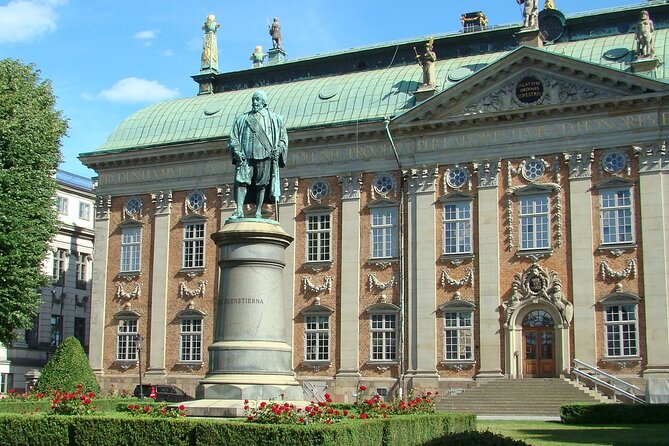
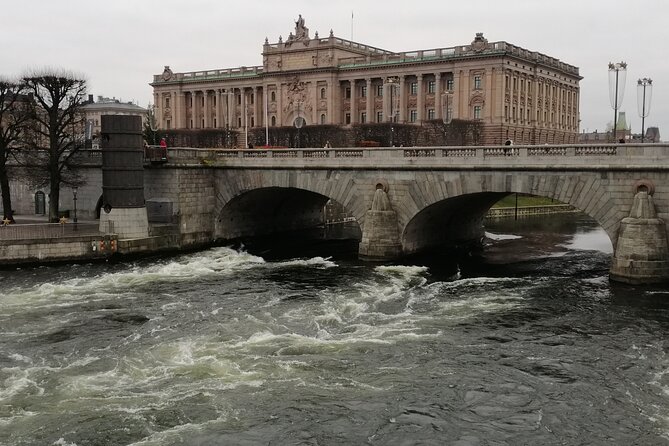
Stop 2 moves from royal grandeur to the Swedish government story at Parliament Building (Riksdagshuset). The building is described as Neo-Renaissance with a Neo-Baroque facade section. That mix matters, because it signals how formal and theatrical politics can look when it is built to last.
You also get a clear construction date anchor: it was built between 1897 and 1905. So you can place it historically in the modern state-building era.
The guide then walks through how Sweden’s legislature evolved:
- The earlier system was the Riksdag of the Estates (Ståndsriksdagen), with the Nobility, Clergy, Burghers, and Peasants meeting separately, before meeting the King in the palace.
- This structure was dissolved in 1866.
- In 1866, a two-chamber parliament was introduced, but with no equal voting rights for all citizens.
- The first elections with general suffrage were held in 1921, after a long political struggle led by liberals and socialists.
- In 1975, the constitution changed, merging the two chambers into one, and confirming that the king has a representative role without real power.
That’s a lot of political history in a small amount of time, but it fits the walk because the building itself becomes your visual reminder. You stop at one place, then you mentally “zoom out” to the larger story.
This stop is about 10 minutes and also marked as admission ticket free.
The possible drawback
Because it is a short stop, you will not get to read every plaque or linger like a museum visitor. If you love political history, you may want to follow up on your own after the walk.
Riksbron bridge views: government, nobility, and the Nobel banquet connection
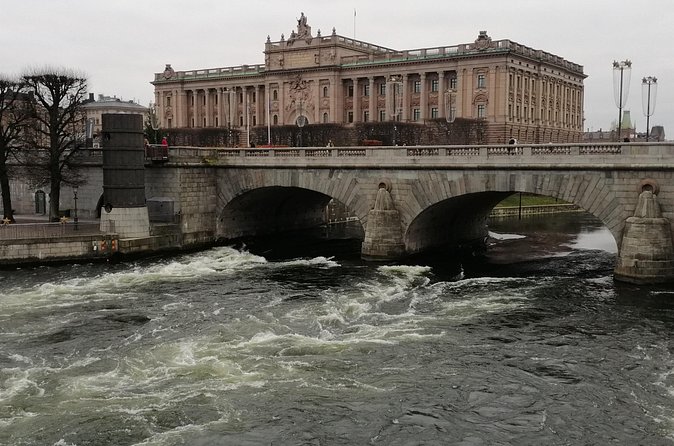
Stop 3 is at Riksbron, the bridge viewpoint. This is one of the tour’s best “get it all in one glance” moments.
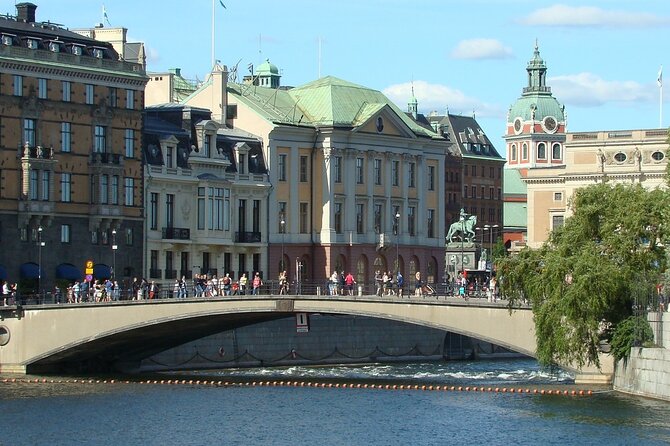
From the bridge, you can marvel at:
- Knights Island
- the Prime Minister’s residence
- the Government building
- the House of Nobility
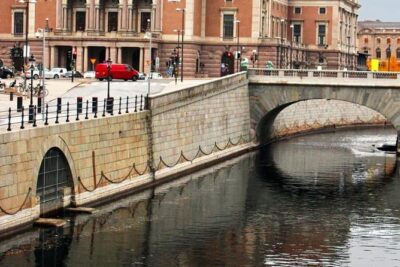
You also get the City Hall in view. The key detail here is that the Nobel prize banquet is held at City Hall every year. Even if you do not plan a Nobel-related museum visit on the same day, it is a helpful fact. It turns a waterfront cityscape into a living stage tied to global events.
This stop is about 15 minutes, and again listed as admission ticket free.
Lejonbacken: the photo stop by the Royal Palace, plus Karl XII and the Grand Hotel
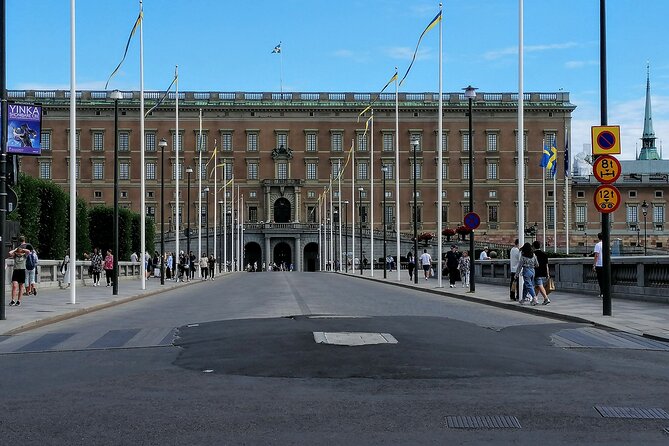
Stop 4 is Lejonbacken, on the north side of the Royal Palace. This is one of the most popular photo spots in Stockholm, and the reason is obvious once you stand there: the view is framed with royal gardens, palace proximity, and city architecture lines.
The tour connects the spot to 17th and 18th-century Sweden as a northern European great power. You see the Royal Garden and a statue of Karl XII, described as the last of the Swedish warrior kings. Karl XII is one of those names that keeps reappearing around Stockholm, so if you learn him here, the rest of your city walk makes more sense.
To the right of the park, you also see the Financial District, built around the turn of the 20th century, when architectural styles were flowering in different directions. That helps you understand that Stockholm’s look is layered, not one single era.
And yes, you also see the Grand Hotel, noted as the most prestigious hotel in Stockholm, where Nobel laureates stay during Nobel prize awarding ceremonies. It is another Nobel link, but this time tied to the hospitality side of the event.
Stop time is about 15 minutes, with admission ticket free.
A practical tip
If your day is windy or cool, you will feel it here more than in the narrow Old Town streets. Bring a layer. One review specifically mentioned wind, and it checks out with the bridge and open-view nature of these stops.
Slottsbacken and the Palace Chapel: a short interior moment
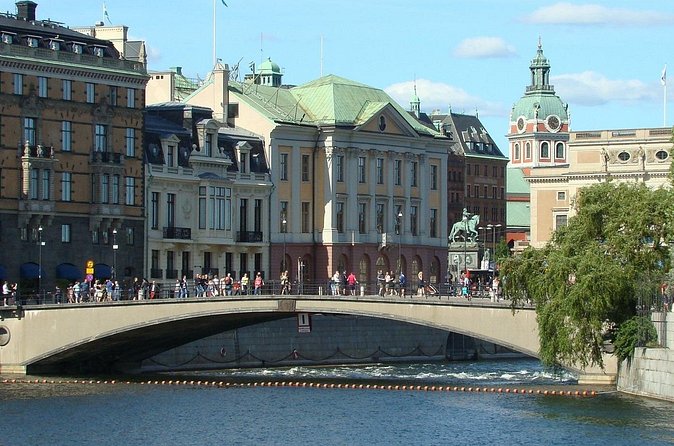
Stop 5 is Slottsbacken. Here you pass the inner courtyard of the Royal Palace and make a short visit to the Palace Chapel, where the Royal family baptizes their children.
That short interior touch is valuable because it breaks up the pure exterior sightseeing. Even a brief chapel visit can change how you feel about the palace complex. The palace stops being only “big and official” and becomes personal and ceremonial.
Outside the Royal Palace, you also see a statue of Carl XIV Johan. The guide explains his career arc: he rose through the Napoleonic army, then was adopted into the Swedish royal family. He is described as the first from the Bernadotte dynasty, the longest royal dynasty in the world that is still ruling.
The story continues in a way that makes Carl XIV Johan feel practical, not just royal. He was imported from France to Sweden to help regain what Sweden lost to the Russians during the Napoleonic wars. But instead of focusing only on war, he worked on diplomacy, infrastructure, and education.
The tour even connects the story to modern reflection: in 2014, Sweden celebrated 200 years of peace. Then you get the idea of how welfare-state foundations were shaped by the industrial revolution, natural resources, and major Swedish inventions.
This stop is about 10 minutes, with admission ticket free.
Stortorget: the square where Stockholm’s violence and Nobel fame overlap
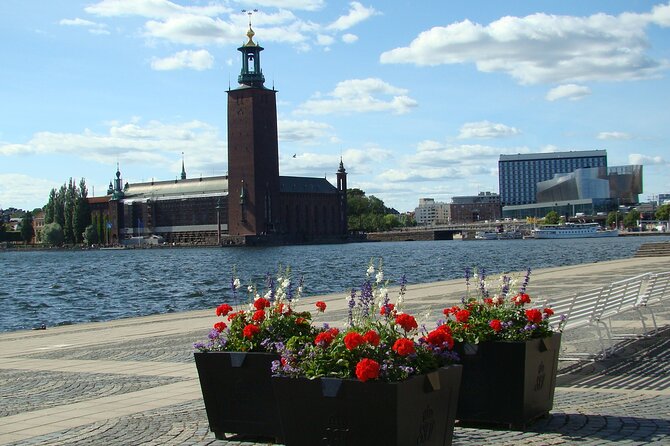
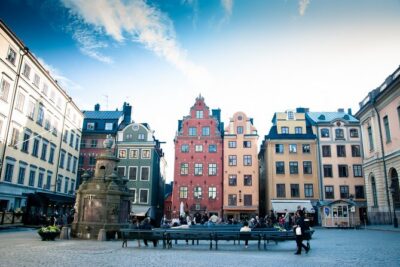
Stop 6 is Stortorget, the central square in Old Town and one of the most photographed places in Stockholm.
It is ringed by buildings in two style waves:
- 17th-century Scandinavian Renaissance
- 18th-century Classicism
Then the guide drops in a story that changes the mood fast: the Bloodbath of Stockholm took place in November 1530. Around 100 noblemen and priests were beheaded by the Danish king Christian II, who is known in Sweden as Christian the tyrant.
That event is not just a dramatic tale. It is part of how you read this city. Squares like Stortorget were not only for markets and festivals. They were also stages where power made itself felt in the harshest ways.
Right in the same square, you can find the Nobel Prize Museum. The tour notes that Swedish Royal Academies and other committees designate winners of the Nobel Prizes across many important fields of science and art. So you have a striking contrast in one small geographic zone: brutal 16th-century politics beside a modern global awards institution.
Stop time is about 15 minutes, with admission ticket free.
Gamla Stan walking segment: Köpmangatan since 1350 and Skeppsbron at the waterfront
Stop 7 is the Old Town stretch where the tour turns from “named stops” into a walking story. From Stortorget you walk along Köpmangatan, the Merchants Street. It has written mentions since 1350, which is an easy detail to hold onto as you move through narrow lanes.
The route includes narrow alleyways meant to help you feel medieval atmosphere. You then pass along Österlånggatan and continue down toward Skeppsbron, the waterfront area where ships have loaded cargo since the 17th century.
This is where the walk earns its keep even if you are not chasing photos. The guide’s job here is to help you see patterns: where merchants lived, where streets squeezed tight, and why the waterfront mattered for everything from everyday trade to big political changes.
This stop is marked as about 20 minutes, with admission ticket free.
Price and logistics: is $106.42 good value for this route?
Here is how I think about the value.
You are paying for:
- a small group of up to 10 people
- English explanations (not just a self-guided audio route)
- clear stop sequencing across royal sites, government buildings, and Old Town
- admission ticket free notes for the listed sights
- a focused 1 hour 45 minutes that fits a typical day in Stockholm
Could you do parts of this on your own? Sure. You could map the sites and wander Gamla Stan. But the practical advantage of a guided route is not the map, it is the connections. Learning how the parliamentary system changed, why the king’s power is only representative now, why City Hall matters for the Nobel banquet, and why Lejonbacken is tied to Karl XII, all of that is exactly what gets hard to piece together alone when you are tired from jet lag and walking.
At this price point, the “win” is that you come away with a mental framework you can reuse. You can point to buildings and explain what you are looking at without turning your day into homework.
What kind of traveler this suits best
This tour fits best if you like:
- short, high-quality city walks
- big-picture history told through real buildings
- photo viewpoints plus practical street-level wandering
- an easy schedule, roughly 1 hour 45 minutes, rather than a full-day grind
It may be less ideal if you:
- want a long museum-style visit inside major sites
- expect hands-on, hours-long access rather than quick stops and external storytelling
- are not comfortable with moderate physical walking (the tour lists a moderate physical fitness level)
Should you book this small group walk?
I would book it if you want a guided hit of Stockholm in a compact time window. The route links royal, governmental, and Old Town layers in a way that helps you make sense of the city quickly. And with a maximum group size of 10 plus English delivery, it is built to keep the experience conversational and easy to follow.
If you already know a lot of Swedish history and want deep museum time, you may feel this is just the appetizer. But for most first visits, it is a solid way to get your bearings fast, then use the rest of your day to choose what to explore further.
FAQ
How long is the Stockholm walking tour?
The duration is listed as approximately 1 hour 45 minutes.
Is the tour offered in English?
Yes, the tour is offered in English.
What is the group size?
The tour has a maximum group size of 10 travelers.
Where does the tour start?
The start point is Gustav Adolfs torg, 111 52 Stockholm, Sweden.
Where does the tour end?
It ends at the Karl XII Statue area (Karl XII:s torg 9, 111 47 Stockholm) and specifically at the southern end of Kungsträdgården.
Are there admission tickets required for the stops?
The tour lists Admission Ticket Free for the stops included on the route.
Do I need a mobile ticket?
Yes, the tour includes a mobile ticket.
Is the tour physically demanding?
It’s recommended for a moderate physical fitness level.
When will I receive confirmation?
Confirmation is received at the time of booking.
What is the cancellation policy?
You can cancel up to 24 hours in advance for a full refund. If you cancel less than 24 hours before the start time, the amount paid is not refunded.
Other Swedish Outings We Reviewed

Reviewed Across Sweden


Stockholm, A Few More Ways
Other Swedish trips from the review pile
- ROYAL Castle Skokloster and Viking Sigtuna (private tour)
★ 4.5 · 3 reviews - Stockholm Port to Stockholm Arlanda Airport (ARN) – Departure Private Transfer
★ 3.5 · 3 reviews - Stockholm Ghost Hunt: Self-Guided Tour and Puzzle Adventure
★ 4.5 · 3 reviews - Private Photography workshop in Stockholm
★ 5.0 · 3 reviews - Private blood, ghosts and folklore Old Town 2h Stockholm tour
★ 4.0 · 3 reviews - Ghosts of Stockholm: A Guided Tour of Horror and Dark Folklore
★ 4.5 · 3 reviews
Stockholm City Tours, compared.
 ★ 4.3City Archipelago Sightseeing Cruise with GuideFrom $4110,798 reviews
 ★ 4.5Skansen Open-Air Museum Admission TicketFrom $273,427 reviews
 ★ 4.4Archipelago Boat TourFrom $393,110 reviews
 ★ 4.3Highlights Boat TourFrom $392,542 reviews
 ★ 4.1Stockholm Pass: Save up to 50% – Includes Vasa Museum TicketFrom $952,392 reviews
 ★ 4.7Ghost Walk and Historical TourFrom $312,206 reviews
 ★ 5.0Walking Tour of Stockholm Old TownFrom $241,175 reviews
 ★ 4.5The Original Stockholm Ghost Walk and Historical Tour – Gamla StanFrom $381,165 reviews
Browse the lists this tour appears in