
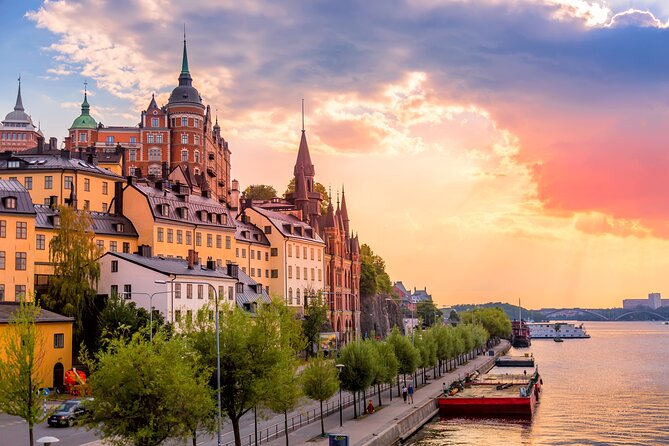
REVIEW · STOCKHOLM
Classic Stockholm Small Group Walking Tour | 3 Hours
Stockholm tells its story on foot. In about three hours, you move from Södermalm into Old Town and finish at Stockholm City Hall, with an English-speaking guide from Adding:tours who makes the whole route feel personal. Two things I really like are the small-group feel and the way the guide turns street corners into clear stories, with folks like Kenneth and Rachel earning repeat praise for answering questions as you walk. One watch-out: you will be on cobblestones, and there is a highlight walk up 36 steps at Mårten Trotzigs Gränd, so good shoes help a lot.
Before you start, you get an email with where to meet and how to get there. You also get a phone number for help if you get stuck or your ride drops you in the wrong spot, and at least one guide has handled that by meeting guests where they actually ended up.
In This Review
- Key highlights you will feel right away
- A 3-hour loop from Södermalm to City Hall
- Meeting at Götgatan 1 and how the start stays smooth
- Södermalmstorg and Slussen: where Stockholm changes shape
- Järntorget, Mårten Trotzigs Gränd, and the alley where you feel history
- German and Finnish church stories: St. Gertrud and the smaller Finska kyrkan
- Runsten and the Nobel Prize Museum block: Vikings to modern symbols
- Storkyrkan’s Saint George, Järnpojken, and small rituals worth copying
- Royal Palace and the city’s shift from court life to courts and parliament
- Rosenbad and Stockholm City Hall: the finale that earns its hype
- Pace, comfort, and how the guide style affects your day
- Price and value: what $66.52 buys you in real terms
- Should you book this Stockholm classic walk?
- FAQ
- How long is the Classic Stockholm Small Group Walking Tour?
- What does the tour cost?
- Where do we meet for the tour?
- Where does the tour end?
- What language is the tour offered in?
- Is a museum or other attraction entry included?
- Do I need a printed ticket?
- Is this tour really small group?
- Is public transportation nearby?
- What if I need to cancel?
Key highlights you will feel right away

- A tight Old Town loop that strings together neighborhoods, not just postcards
- English guide focus on questions so you are not forced to wait until the end
- Södermalm to Gamla Stan to City Hall so you finish with a big payoff
- Tiny details, big meanings like iron industry clues and a Viking rune stone
- No museum tickets needed for most stops, since attractions are not entered
Stockholm is a big menu. Here is what else we tried
- Stockholm: City Archipelago Sightseeing Cruise with Guide★ 4.3 · 10,798 reviews
- Stockholm: Skansen Open-Air Museum Admission Ticket★ 4.5 · 3,427 reviews
- Stockholm: Archipelago Boat Tour★ 4.4 · 3,110 reviews
- Stockholm: Highlights Boat Tour★ 4.3 · 2,542 reviews
A 3-hour loop from Södermalm to City Hall
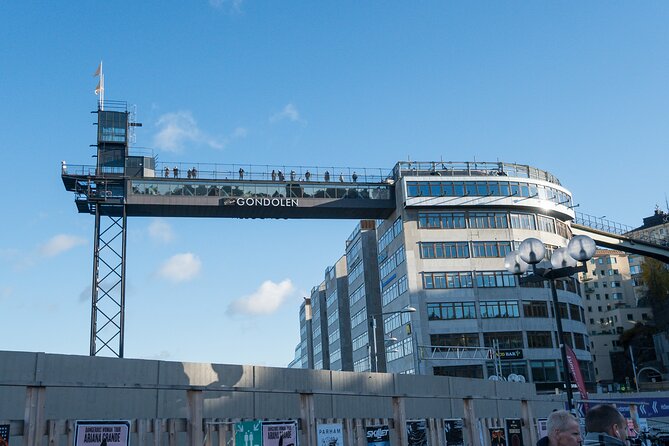
This is a classic first-day Stockholm walk because it gives you the city’s logic, not just its photos. You start in Södermalmstorg, work your way toward Slussen, then head through Old Town lanes and squares until you land at City Hall. The pacing is meant for learning without rushing, and you cover a lot of ground in a short time.
What makes it feel especially worthwhile is the mix of themes. You get royal Stockholm, German and Finnish church communities, Viking-era touches, and Swedish political landmarks all in one continuous walk. By the end, you should feel like you can navigate the city with a bit more confidence, and you will know which areas you want to revisit on your own.
Meeting at Götgatan 1 and how the start stays smooth
The official start is Götgatan 1, 116 46 Stockholm, Sweden, at the east entrance of the Stockholm City Museum (Stockholms Stadsmuseum). You should receive a pre-tour message with detailed directions and a phone number for help. That matters because Stockholm streets can confuse first-time visitors, especially if you arrive by taxi or rideshare and they drop you slightly off.
The tour uses a mobile ticket, and it runs in English. It is also close to public transportation, which is useful if you are combining this with other plans like a museum visit or a harbor ride later.
In terms of group size, this activity has a maximum of 100 travelers, but the experience is still sold as a small-group walk. In the reviews, you can see what that means in real life, including days that felt close to private, where guests could talk like friends rather than listen to a lecture.
Södermalmstorg and Slussen: where Stockholm changes shape
You begin at Södermalmstorg, right at the east entrance of Stockholm City Museum. That first stop sets the tone. Instead of starting with a single landmark, you start with the idea that Stockholm evolved through planning, trade, and constant reshaping of neighborhoods.
Next comes Slussen, literally the lock. This is a prime example of why a guided walk helps. Slussen is not just a busy junction, it is part of Stockholm’s early and ongoing development, and your guide walks you through what has changed and what has been under project work from 2016 to 2025. As you move at a leisurely pace toward Old Town, you start noticing how the city’s geography affects everything from viewpoints to street layouts.
If you are the type who likes architecture and urban planning, Slussen is a satisfying early win. If you are feeling chilly or tired, it is also a helpful moment to reset because the explanation gives context before the cobblestones and narrower lanes begin.
Järntorget, Mårten Trotzigs Gränd, and the alley where you feel history
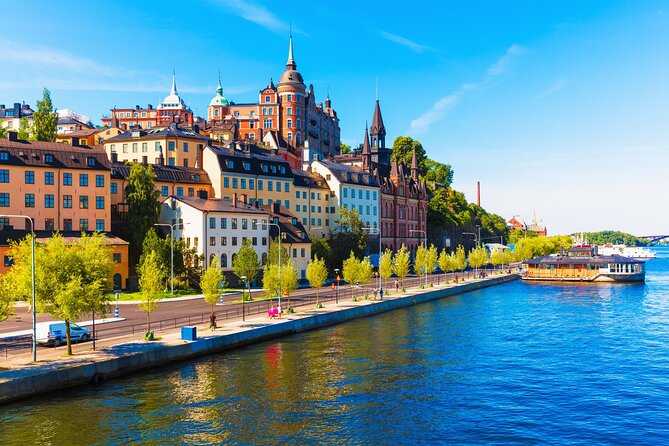
Järntorget is next, the Iron Square. The name points to iron processing and trade, but the guide also connects that past to later roles, including banking and cultural landmarks. This is one of those stops where the story makes the space easier to understand. A square is more than a place to stand. It is where economic power and everyday life overlapped.
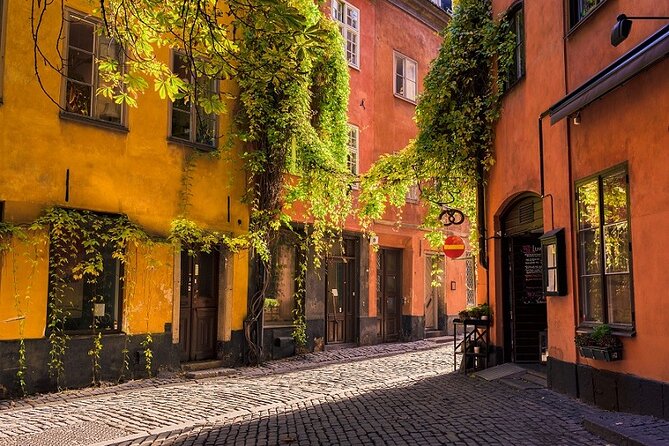
Then you hit a true Stockholm character moment: Mårten Trotzigs Gränd. This is a narrow alley purchased by a German merchant in the 16th century, and it later saw revival and preservation work in the 20th century. You do not just look at it, you walk through it and climb 36 steps. Even if you only care about photos, you will probably feel the charm here because the alley forces you to slow down and look up.
The only drawback at this stage is physical comfort. Cobblestones and stairs can be a lot if your feet are not ready. If you have knee trouble, wear shoes with grip and consider taking the stairs a bit slower than feels natural.
More Swedish streets covered on foot
German and Finnish church stories: St. Gertrud and the smaller Finska kyrkan
After the alley, the route shifts to religious communities that helped shape Stockholm’s language and identity.
At S:ta Gertrud (Tyska kyrkan), you learn how one of the oldest German-speaking parishes outside Germany took root. In 1571, King Johan III granted the Germans the right to form their own congregation. By 1607, they received exclusive rights to a dedicated place of worship. Even if you are not into church architecture, this is a powerful reminder that immigrant communities in Europe often built institutions that lasted for centuries.
Later you visit the Finnish Church (Finska kyrkan). It is part of the same larger story, just with a different origin. The guide shares how it transformed from a royal tennis court into a cherished place of worship, and how its significance is still tied to belonging and community.
Both stops work well because they are not presented as facts in isolation. You understand why these buildings existed where they did, and how Stockholm became a city of multiple cultural threads living close together.
Runsten and the Nobel Prize Museum block: Vikings to modern symbols
One of the quickest history-to-now connections comes at Runsten, specifically Rune Stone U 53. A rune stone is not a museum object sealed behind glass. It is a preserved piece of evidence that connects modern Stockholm with its Viking roots. The guide’s point here is simple but moving: careful preservation lets the past stay present.
You then move through the area tied to Nobel fame and Stockholm’s central civic center. The route brings you past the Nobel Prize Museum, inaugurated in 2001, connected to the historic Stock Exchange building. Even though attractions are not entered, you still get the context that makes the location feel meaningful.
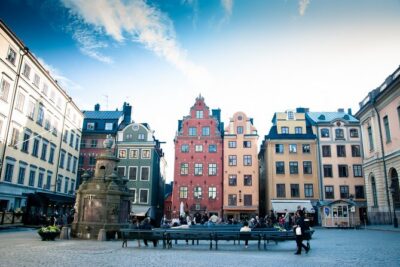
After that, Stortorget enters the story. This is Stockholm’s oldest square and the original heart where the city grew. You also hear about the Stockholm Bloodbath, November 7 to 9, 1520. If you have ever visited squares in other cities, you know how bland they can feel without context. Here, the guide gives you the emotional weight behind the stones.
In this same area, the guide points out architectural highlights and nearby landmarks you can keep noticing after the tour, like the Stock Exchange Building and other surrounding historic houses. There is even a fun local detail about Stortorgs Källaren being connected to a cannonball story, plus the fact that a famous ABBA photograph was taken at the fountain in 1976. Those kinds of touches are exactly why a walk with a good guide is better than reading a brochure.
Storkyrkan’s Saint George, Järnpojken, and small rituals worth copying
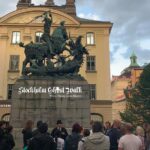
Old Town gets medieval fast, and you see it at St. George and the Dragon. The statue is housed at Stockholm Cathedral (Storkyrkan). You learn about the original wooden sculpture placed in the cathedral in 1489 and the strong belief that it was commissioned to commemorate victory tied to the Battle of Brunkeberg in 1471.
You are not just hearing about a legend. You are connecting it to power struggles and national memory. The guide also helps you understand why this sculpture remains a symbol of courage and triumph, even if you are seeing a replica form or the story behind it rather than a full art history lecture.
Then you get a very Stockholm moment at Jarnpojken (the Iron Boy). This small sculpture has an intimacy that is hard to explain until you see it. People leave coins, pat its head, and knit little garments for it in winter. It is a tiny tradition, but it is also a reminder that public art can stay human and playful, not just ceremonial.
If you want a souvenir that feels more meaningful than a magnet, spending a minute at Jarnpojken does the trick. It is also a great break point if your feet are starting to feel the cobblestones.
Royal Palace and the city’s shift from court life to courts and parliament
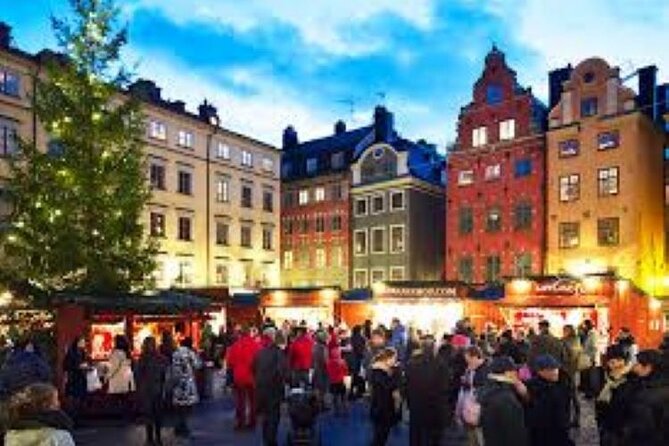
The walk then moves into the realm of power, where Stockholm shows you what it values.
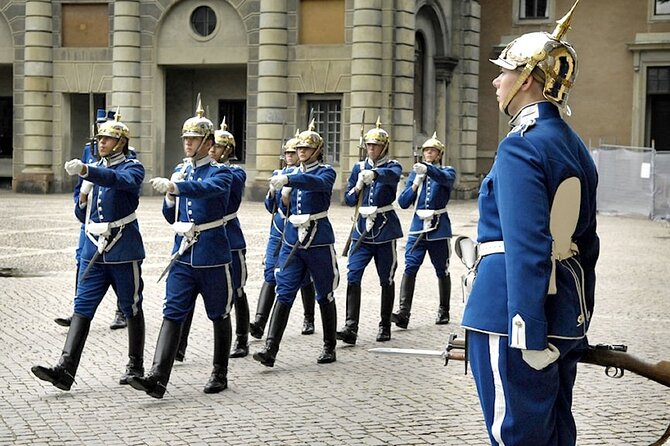
At the Royal Palace, you get a timeline that starts in the late 13th century. The guide links the palace to the medieval complex called Tre Kronor and points out major interiors you might want to read about later, including the Hall of State and the Royal Chapel. The guide also shares what to look for outside in the context of statues and symbolism, like figures tied to Swedish rulers.
Next comes Riddarholmen, the island with the Grey Friars Monastery built in the 1200s. After the Tre Kronor castle fire in 1697, state agencies and courts took over much of the island. The result is a living mix of medieval architecture and legal or administrative functions, including Riddarholm Church and a statue for Evert Taube.
Then you pass by the House of Nobility (Riddarhuset), built between 1641 and 1674. This is managed by Sweden’s nobility, and the building is still a symbol of that heritage. After that, the route includes Bonde Palace, where Sweden’s Supreme Court sits. Even without entering, the guide helps you connect the building’s role to the idea that Swedish justice has deep institutional roots.
You also see the Parliament Building (Riksdagshuset), built from 1895 to 1904. The bicameral system change in 1971 and later renovations are part of the story. You learn that the former bank section was adapted for the new plenary, and you hear about the statue known as The Homeless Fox. The tour also ties in political context with a note about where the Prime Minister’s official residence is, since 1995, at Sergerska Palatset.
If politics is not your usual travel topic, you will still likely enjoy this portion because it is grounded in real place. You start to see Stockholm as an operating machine, not just a museum city.
Rosenbad and Stockholm City Hall: the finale that earns its hype
The penultimate stop is Rosenbad, a key seat of Swedish government. Even as a brief stop, the guide frames it as a symbol of democracy and governance. That framing helps you understand why Stockholm’s political buildings are designed to feel both official and part of public life.
Finally, you end at Stockholm City Hall. The building’s mix of Italian Renaissance and Nordic Gothic influences, plus National Romantic style touches, is the architectural headline. You hear why the Blue Hall and Golden Hall matter for major events, including the Nobel Banquet. The best part of finishing here is that it gives your walk a clear endpoint. You are not just wandering out of Old Town. You are landing at a place that feels like a modern civic crown.
Because attractions are not entered on this tour, City Hall is more about exterior appreciation and guide context than an indoor visit. Still, it is a strong finish, especially if it is your first day and you want a landmark that helps you orient the rest of your trip.
Pace, comfort, and how the guide style affects your day
A 3-hour walking tour can feel either long or quick. This one tends to feel quick because the guide keeps the route lively and interactive. In multiple reviews, the same theme shows up: guides like Kenneth and Rachel are friendly, flexible, and willing to answer questions right as they happen. That matters because you get answers while the location is still in front of you, not hours later.
You also get local advice for cafes and restaurants, which is a practical perk on your first day. It is not just about seeing sights. It is about turning your time after the tour into a good meal and a low-stress plan.
Comfort-wise, plan for moderate fitness. The route includes cobblestones and at least one stair highlight at Mårten Trotzigs Gränd. If you take medication that affects balance, or you have an existing knee condition, go slow and consider bringing trekking-style support if you use it at home.
Price and value: what $66.52 buys you in real terms
At $66.52 per person for roughly three hours, the price looks reasonable when you translate it into what you are actually getting.
You are paying for:
- An English in-person guide
- A route that covers many meaningful stops in one pass
- On-the-spot Q&A style, with guides who make time for your questions
- Local restaurant and cafe recommendations
- A walk that does not require you to pre-book multiple ticketed entries
What you are not paying for is museum admissions. Entry fees for museums and special sites are not included, and the tour is structured so attractions are not entered. That is not a flaw, it is the business model. It keeps the tour moving and makes it easier to fit into a tight schedule.
So who does this fit best? If you want a strong overview day without stacking tickets, this is a good match. If you want deep time inside museums for hours on end, you might prefer to add separate ticketed visits after the tour.
Should you book this Stockholm classic walk?
Book it if:
- You want a guided orientation to Stockholm, from Södermalm toward Old Town and over to City Hall
- You enjoy history that feels connected to real streets
- You want restaurant guidance for after your walk
- You like routes where you can ask questions while you are standing in front of the story
Skip it or pair it differently if:
- You know you cannot handle cobblestones or stairs like the 36-step Mårten Trotzigs Gränd
- You mainly want inside museum time, since attractions are not entered and entry fees are not included
If you are deciding between doing it alone versus with a guide, this one tilts toward the guide. It is not just a list of stops. It is a coherent walk through how Stockholm works, from Viking-era clues and church communities to royal and political power, ending in a place you will remember when you look at your photos later.
FAQ
How long is the Classic Stockholm Small Group Walking Tour?
It runs for about 3 hours.
What does the tour cost?
The price is $66.52 per person.
Where do we meet for the tour?
You meet at the east entrance of the Stockholm City Museum (Stockholms Stadsmuseum). The meeting point is listed as Götgatan 1, 116 46 Stockholm, Sweden.
Where does the tour end?
The tour ends in a different location. The meeting details indicate City Hall as the tour’s conclusion.
What language is the tour offered in?
The tour is offered in English.
Is a museum or other attraction entry included?
No. Entry fees for museums and other special sites are not included, and the attractions are not being entered.
Do I need a printed ticket?
No, the tour uses a mobile ticket.
Is this tour really small group?
It is sold as a small group walking tour, and the maximum number of travelers for the activity is 100. Some bookings have felt very small, based on guide and guest experience described in reviews.
Is public transportation nearby?
Yes, the meeting area is near public transportation.
What if I need to cancel?
Free cancellation is available up to 24 hours in advance for a full refund. If you cancel less than 24 hours before the start time, the amount paid is not refunded.
Other Swedish Outings We Reviewed




Reviewed Across Sweden



Stockholm, A Few More Ways
Other Swedish trips from the review pile
- ROYAL Castle Skokloster and Viking Sigtuna (private tour)
★ 4.5 · 3 reviews - Stockholm Port to Stockholm Arlanda Airport (ARN) – Departure Private Transfer
★ 3.5 · 3 reviews - Stockholm Ghost Hunt: Self-Guided Tour and Puzzle Adventure
★ 4.5 · 3 reviews - Private Photography workshop in Stockholm
★ 5.0 · 3 reviews - Private blood, ghosts and folklore Old Town 2h Stockholm tour
★ 4.0 · 3 reviews - Ghosts of Stockholm: A Guided Tour of Horror and Dark Folklore
★ 4.5 · 3 reviews
Stockholm City Tours, compared.
 ★ 4.3City Archipelago Sightseeing Cruise with GuideFrom $4110,798 reviews
 ★ 4.5Skansen Open-Air Museum Admission TicketFrom $273,427 reviews
 ★ 4.4Archipelago Boat TourFrom $393,110 reviews
 ★ 4.3Highlights Boat TourFrom $392,542 reviews
 ★ 4.1Stockholm Pass: Save up to 50% – Includes Vasa Museum TicketFrom $952,392 reviews
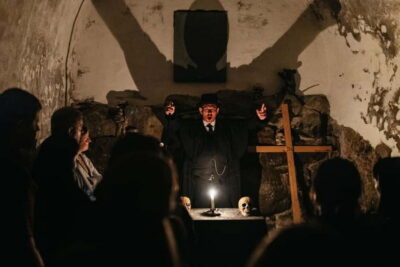 ★ 4.7Ghost Walk and Historical TourFrom $312,206 reviews
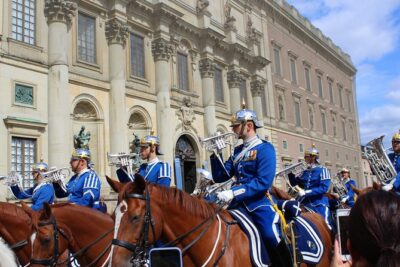 ★ 5.0Walking Tour of Stockholm Old TownFrom $241,175 reviews
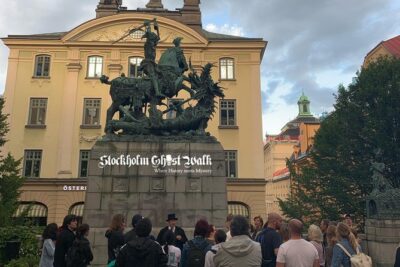 ★ 4.5The Original Stockholm Ghost Walk and Historical Tour – Gamla StanFrom $381,165 reviews
Browse the lists this tour appears in