
REVIEW · STOCKHOLM
The Story of Stockholm and Sweden in Three Chapters, a Small Group Walking Tour
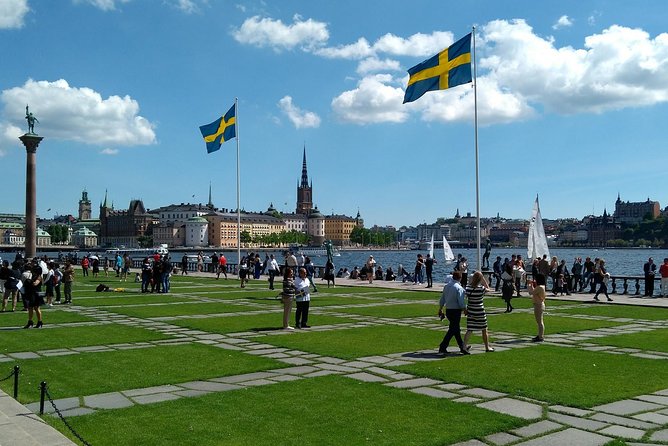
A good walking tour can turn random landmarks into a story. This one strings together Stockholm and Swedish history in three clear chapters, and it does it without ticket-line stress. I especially like the small group size (10 max) and the way the route connects early power struggles to modern Sweden, including links to companies like Spotify and IKEA. The main thing to consider is the pace: it is a 2-hour walk with short stops, so you will get a strong overview, not a slow, in-depth museum day.
You start in central Old Town, work your way around key historic buildings, and end near Stortorget at the right moment to catch the changing of the guards. Expect a talk that moves fast but stays grounded in real places, statues, and institutions you can point to right away. If you want a history tour that helps you get your bearings fast, this is built for you.
In This Review
- Key Points at a Glance
- Why This Three-Chapter Walk Makes Stockholm Click
- Price and Value: What You Get for $61.28
- The Route Start: Gamla Stan Underground and a Clear Meeting Point
- Stop 1: Riddarholmen Historical Marker and the Earliest Sweden Story
- Stop 2: Riddarholmen Church, Birger Jarl, and the 1252 Moment
- Stop 3: Riddarhuset and Gustav Vasa, Sweden’s Break and Bloodbath
- Stop 4: Vasabron and the Warrior-King Era
- Stop 5: Riksdagshuset and How Sweden’s Parliament Evolved
- Stop 6: Royal Palace Area, Karl XII, Poltava, and the Enlightenment Shift
- Stop 7: Old Town and Carl XIV Johan, Peace, Industry, and Innovation
- Stop 8: Stortorget, the Nobel Connection, and Changing of the Guards Timing
- Who This Tour Fits Best (and Who Might Want Something Else)
- Quick Practical Tips Before You Go
- Should You Book This Three-Chapter Stockholm Tour?
- FAQ
- How long is the tour?
- How big is the group?
- What language is the tour in?
- Is admission included?
- Where does the tour start and end?
- What time does the tour begin?
- Do I get a mobile ticket?
- Is the tour suitable for people with limited mobility?
- What is the cancellation policy?
Key Points at a Glance
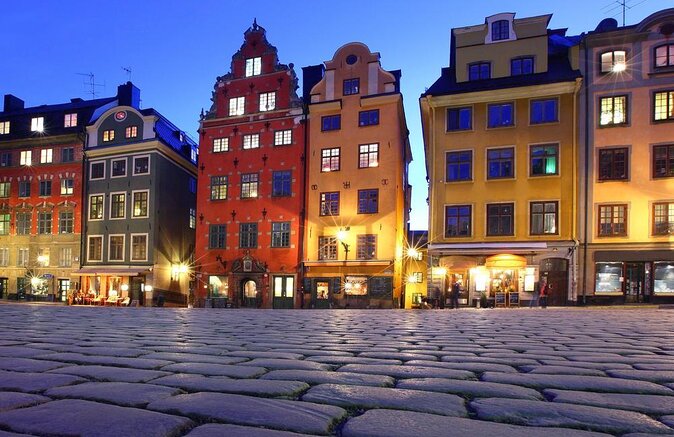
- Three chapters of Swedish history tied to specific stops, from the earliest settlements to the welfare-state era
- Admission included along the way, so you do not waste time in ticket lines
- Small-group format capped at 10 people, which usually means better questions and a less chaotic walk
- Mobile ticket delivery and an English-speaking guide experience
- Hands-on context for why Gustav Vasa, the parliament system, and later kings shaped modern Sweden
- Great ending location near Stortorget and the Royal Palace, timed for the changing of the guards
Stockholm is a big menu. Here is what else we tried
- Stockholm: City Archipelago Sightseeing Cruise with Guide★ 4.3 · 10,798 reviews
- Stockholm: Skansen Open-Air Museum Admission Ticket★ 4.5 · 3,427 reviews
- Stockholm: Archipelago Boat Tour★ 4.4 · 3,110 reviews
- Stockholm: Highlights Boat Tour★ 4.3 · 2,542 reviews
Why This Three-Chapter Walk Makes Stockholm Click
Stockholm can feel like a collection of pretty postcard stops. This tour helps you understand the logic underneath the scenery. Instead of jumping around, it guides you through a timeline that is easy to remember: early foundations, the break from older rule and religion, then Sweden’s later political and cultural arc.
What I like most is that the story is attached to things you can physically see. You are not just hearing dates. You are standing near markers, churches, noble institutions, and royal viewpoints while the guide explains how leaders and ideas changed the country. That makes your next self-guided walk through Gamla Stan feel sharper and more intentional.
The other big win is the pacing that still respects your time. In about 2 hours, you cover the core Old Town narrative, then finish where many people want to go anyway, near the palace and Stortorget.
Price and Value: What You Get for $61.28
At $61.28 per person for about 2 hours, this tour sits in the mid-range for Stockholm guided walks. The value comes from two things that matter in real life while traveling.
First, admission is included along the way. That is not a small detail. It can save you both time and hassle, especially in a historic city where ticket lines and timed entries can eat into your day.
Second, the group is capped at 10. When a tour is larger, you lose some of the give-and-take. Here, the format is built for people who want to listen closely, ask quick questions, and keep up without feeling shoved along.
The Route Start: Gamla Stan Underground and a Clear Meeting Point
You meet at Gamla Stan Metro station, specifically inside or under ground, in front of the Pressbyrån kiosk. The start address is Munkbrogatan 8, 111 27 Stockholm, and the tour starts at 10:00 am.
This matters because Gamla Stan is busy and signage can be a little confusing when you are arriving in the morning. Starting at a transit hub keeps you anchored. Also, if you are coming from nearby hotels, you can often get there without complicated routes.
If you arrive early, you will have time to find the kiosk area. Also, consider that the tour begins indoors or underground and then transitions to outdoor Old Town walking.
Stop 1: Riddarholmen Historical Marker and the Earliest Sweden Story
The first chapter starts at a Riddarholmen historical marker after you gather at the Gamla Stan Metro stop. The guide sets the stage with early history, from the ice age and the first settlements on the islands.
This opening is useful because it prevents the common Stockholm problem, which is only learning about kings and battles while ignoring why this geography mattered. When you understand the islands, waterways, and early settlement patterns, later events in the story feel less random.
You also get time to walk around and visit open parts of the palace. The stop is about 15 minutes, and admission is ticket-free for you as part of the included flow.
Potential drawback here: because it is early in the tour, you may want to listen with focus. If you are slow to wake up, the ice-age setup might feel like a lot at once. The upside is that it gives you a mental framework for everything that follows.
More Swedish streets covered on foot
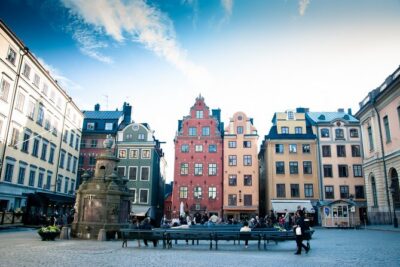
Stop 2: Riddarholmen Church, Birger Jarl, and the 1252 Moment
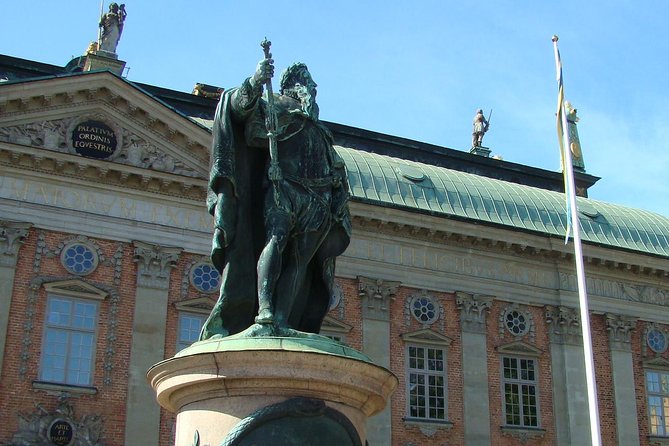
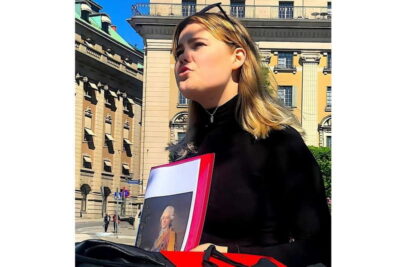
Outside Riddarholmen Church, you will meet the presumed founder of Stockholm, Birger Jarl, or a statue representing him. The key detail is 1252, the year when the name Stockholm first appears in a written text preserved until today.
This is one of those moments where a guide’s job is to make a date feel like a turning point instead of a trivia number. Birger Jarl is presented as a foundational figure, and the point of the stop is to show how Stockholm moved from settlement into a named, documented place.
This segment is short, about 10 minutes. So the best strategy is to treat it as a setup, not a deep dive. Look at the church exterior, note the statue, and let the guide connect the dots.
Stop 3: Riddarhuset and Gustav Vasa, Sweden’s Break and Bloodbath
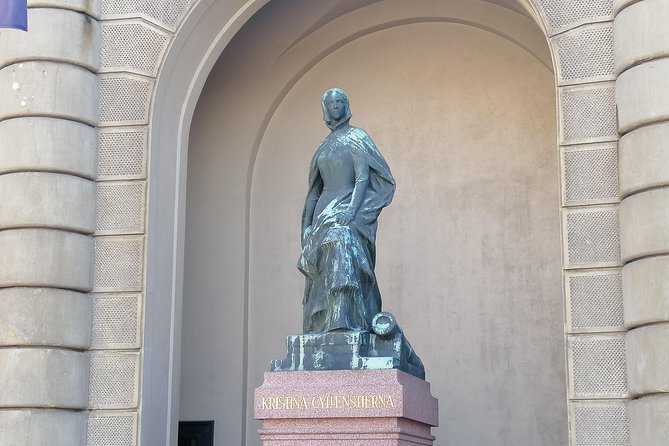
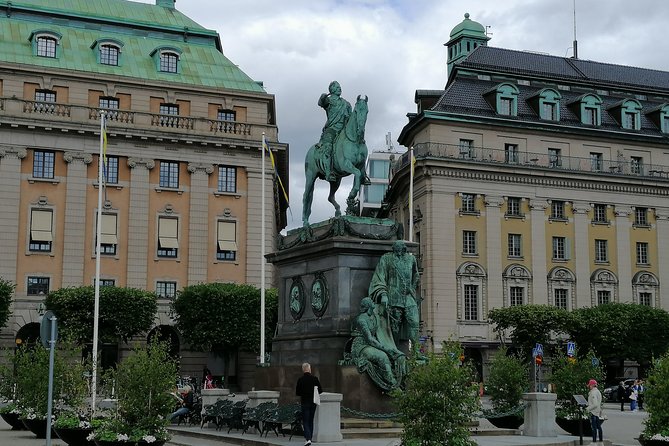
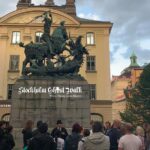
Next you stop at Riddarhuset, the House of Nobility. Outside, you look at the statue of Gustav Vasa, described as the father of Sweden.
Here the tour switches into Chapter Two. You get the dramatic story line: in 1523, Gustav marched into Stockholm. The tour frames this as a major shift toward Sweden being a sovereign state, not something controlled by foreign powers.
Then comes the most intense part of the chapter: “the bloodbath of Stockholm,” where 80 to 100 noblemen linked to earlier power were killed as part of an uprising against a southern neighbor that held control over Sweden. The guide also explains how Gustav’s actions helped change religion from Catholicism to Lutheran Protestantism.
If you like your history with real stakes, this is the stop. Just be aware it is also the darkest part of the story. The pacing here keeps the narrative moving, but it still gives you enough context to understand why these changes mattered.
Stop 4: Vasabron and the Warrior-King Era
From Riddarhuset you cross over to Vasabron, where the guide talks about Gustav Vasa’s heirs and the country that grew out of his decisions.
You will hear about Gustav II Adolf, Gustav Vasa’s grandson, often described here as the greatest of the warrior kings. The big takeaway is the role of the Baltic Sea. Under his rule, the Baltic became almost like an inland sea, with Sweden surrounded by Swedish possessions.
Even if you do not remember every name, you will walk away with a feel for Sweden’s strategic obsession: control of sea routes and influence around the Baltic.
Stop length is about 10 minutes. It is enough for context, but not long enough to satisfy someone who wants a detailed military lecture.
Stop 5: Riksdagshuset and How Sweden’s Parliament Evolved
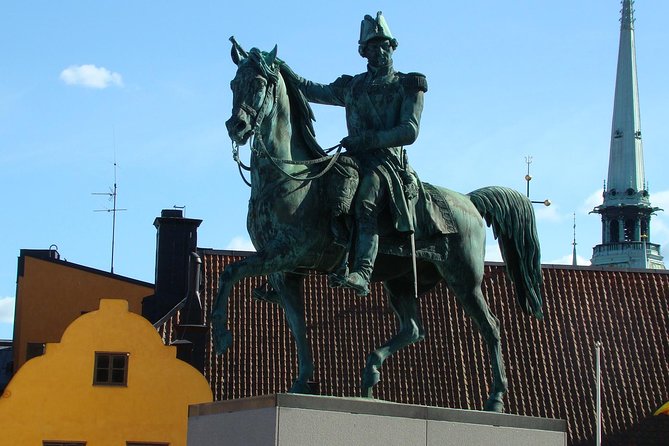
At Riksdagshuset, the parliament building, the tour moves from kings to institutions. The guide explains the predecessor: the Riksdag of the Estates (Ståndsriksdagen), where nobility, clergy, burghers, and peasants met separately, then came together with the king in the palace.
You also learn how long that system lasted, until 1866, when a parliament with two chambers was introduced. Still, the big point here is that it did not yet give equal voting rights for all citizens.
Then you get to 1921, when elections with general suffrage finally happened after a long political struggle led by liberals and socialists.
This stop is only around 10 minutes, but it is one of the most useful pieces if you plan to understand modern Sweden. It answers a very practical question: why did Sweden’s democracy grow gradually, and how did social classes shape politics before full voting rights?
If you are the type who likes to connect today’s headlines to earlier systems, you will appreciate this.
Stop 6: Royal Palace Area, Karl XII, Poltava, and the Enlightenment Shift
The tour’s Chapter Three starts at Lejonbacken, on the north side of the Royal Palace. This part is more about pivot points, when Sweden’s ambitions collided with reality.
First up is Peter the Great of Russia, credited with ending Sweden’s northern great-power dreams. Then you get the story of Karl XII, the last of the warrior kings, whose statue points east. The guide connects that directional symbolism to victories and then the turning defeat in Poltava in 1709, where Karl XII’s army was beaten by Peter the Great.
Then the story shifts toward the Enlightenment. As arts and science gained attention, Swedish culture changed too. Gustav III is highlighted as an enlightened despot who cared about theater and contributed to arts in that era.
This stop is about 10 minutes, so it is not about memorizing battles. It is about showing the big mood change in Sweden, from pure military ambition to a broader cultural and intellectual life.
Stop 7: Old Town and Carl XIV Johan, Peace, Industry, and Innovation
Below the statue of Carl XIV Johan, the guide continues the narrative into Sweden’s modern foundation. Carl XIV Johan is described as the first of the Bernadottes, imported from France early in the 19th century.
The tour explains the initial plan, win back territory lost to the Russians. Instead, Carl XIV Johan focused on diplomacy, infrastructure, and education. You also hear about 2014, when Sweden celebrated 200 years of peace.
Then the guide ties the story to the economic engine that helped create a welfare state. The industrial revolution, natural resources, and Swedish inventions are described as key building blocks. It is here the tour also links into modern Swedish entrepreneurship, including how ideas and institutions helped support companies like Spotify and IKEA.
This part lasts about 20 minutes, longer than most stops. That extra time is a good sign if you care about the transition from monarchy to modern civic life.
If you only have energy for one stop, this is a strong candidate. It helps you connect your evening plans in Stockholm to the “why” behind Sweden’s reputation for innovation and social stability.
Stop 8: Stortorget, the Nobel Connection, and Changing of the Guards Timing
You finish at Stortorget, where the Nobel Prize Museum is located. The guide explains that the Swedish Royal Academies designate winners of major prizes in science and art.
This ending works because it bridges the tour’s earlier institutions to a modern global role for Sweden. It also helps you understand the symbolism of Swedish national prestige. The story ends with something you can build on instantly, since you are already in the square where people naturally want to go.
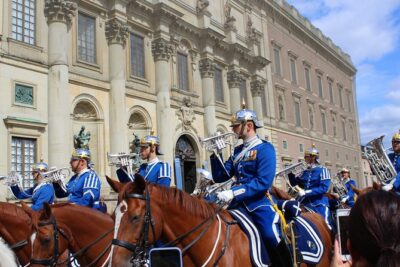
The tour also ends close to the Royal Palace in time to catch the changing of the guards. In summer months, the parade marches or rides with the Music Corps through up to the outer courtyard of the palace.
If your travel schedule includes late afternoon sightseeing, you might love that the tour drops you into a perfect location. It means you spend less time figuring out logistics and more time watching something memorable.
Who This Tour Fits Best (and Who Might Want Something Else)
This is a great match if you want:
- A clear storyline for Stockholm’s past, not just random facts
- Short, efficient stops that are still meaningful
- An easy start point near major transit
- A small group that stays manageable at 10 people
It may not be the best fit if you want:
- A slow museum day with long interiors and deep reading time
- Extra time for photos at every stop
Also, the tour recommends moderate physical fitness, which makes sense for a walking route through Old Town. If you have mobility limits or tire quickly, you should think about whether 2 hours of steady walking is comfortable for you.
Quick Practical Tips Before You Go
- Plan on Old Town streets and outdoor walking, then be ready for quick explanations as you move between stops.
- Wear shoes you trust. Even when distances are short, cobblestones can add up.
- If you care about photos, keep your phone accessible and be ready to shoot during brief pause moments, not after the group has moved on.
Should You Book This Three-Chapter Stockholm Tour?
If you are trying to understand Stockholm in one day’s worth of effort, I think this is a smart booking. The educational approach and the fact that it stays organized into three chapters make it easier to remember what you saw, and where it fits in the Swedish story. Add in the small-group cap at 10 and the practical win of admission included along the way, and you get good value for the time.
I would book it if you like walking tours that teach, not just show. I would skip it only if you want a longer, slower pace or you know you will struggle with a moderate level of walking.
FAQ
How long is the tour?
The tour runs for about 2 hours.
How big is the group?
The experience is capped at a maximum of 10 travelers.
What language is the tour in?
The tour is offered in English.
Is admission included?
Yes, admission is included along the way, so you do not need to wait in ticket lines for these parts.
Where does the tour start and end?
It starts at Munkbrogatan 8, 111 27 Stockholm at Gamla Stan Metro station, in front of the Pressbyrån kiosk, and it ends at Stortorget, 111 29 Stockholm, near the Royal Palace.
What time does the tour begin?
The start time is 10:00 am.
Do I get a mobile ticket?
Yes, the tour uses a mobile ticket.
Is the tour suitable for people with limited mobility?
It is recommended for travelers with a moderate physical fitness level.
What is the cancellation policy?
You can cancel for a full refund up to 24 hours in advance of the experience start time. After that, refunds are not available.
Other Swedish Outings We Reviewed



Reviewed Across Sweden



Stockholm, A Few More Ways
Other Swedish trips from the review pile
- ROYAL Castle Skokloster and Viking Sigtuna (private tour)
★ 4.5 · 3 reviews - Stockholm Port to Stockholm Arlanda Airport (ARN) – Departure Private Transfer
★ 3.5 · 3 reviews - Stockholm Ghost Hunt: Self-Guided Tour and Puzzle Adventure
★ 4.5 · 3 reviews - Private Photography workshop in Stockholm
★ 5.0 · 3 reviews - Private blood, ghosts and folklore Old Town 2h Stockholm tour
★ 4.0 · 3 reviews - Ghosts of Stockholm: A Guided Tour of Horror and Dark Folklore
★ 4.5 · 3 reviews
Stockholm City Tours, compared.
 ★ 4.3City Archipelago Sightseeing Cruise with GuideFrom $4110,798 reviews
 ★ 4.5Skansen Open-Air Museum Admission TicketFrom $273,427 reviews
 ★ 4.4Archipelago Boat TourFrom $393,110 reviews
 ★ 4.3Highlights Boat TourFrom $392,542 reviews
 ★ 4.1Stockholm Pass: Save up to 50% – Includes Vasa Museum TicketFrom $952,392 reviews
 ★ 4.7Ghost Walk and Historical TourFrom $312,206 reviews
 ★ 5.0Walking Tour of Stockholm Old TownFrom $241,175 reviews
 ★ 4.5The Original Stockholm Ghost Walk and Historical Tour – Gamla StanFrom $381,165 reviews
Browse the lists this tour appears in