
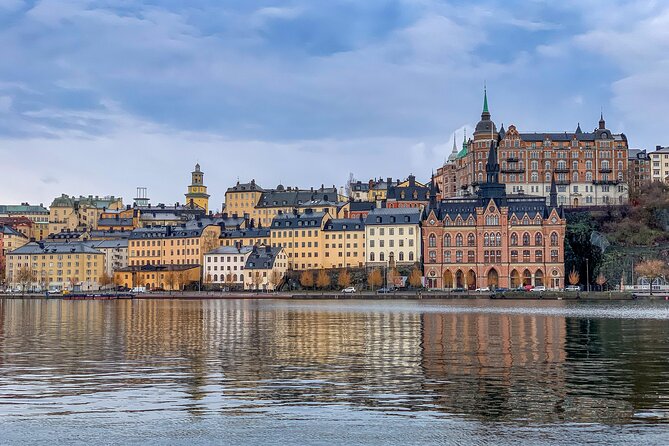
REVIEW · GAMLA STAN
Stockholm: Old Town and City Guided Walking Tour
Stockholm’s Old Town works like a living movie set. In just 2 hours, you get a guided walk through Gamla Stan’s tight lanes and big story moments, from Gustav III to Nobel landmarks, with the option to switch to extra Vox City audio while you go. It’s an easy way to get your bearings fast, even if you only have a short window in the city.
Two things I really like: the live English guide (many walks feel personal, with guides like Laura and Ossi standing out for their friendly, flexible style) and the app bonus that turns the tour into a longer self-guided game plan. One possible drawback: this is mainly outside viewing, since entry to attractions is not included, so you’ll need separate tickets if you want to go inside specific places.
In This Review
- Key highlights you will feel on this walk
- Meeting at Skeppsbrokajen, then stepping into Gamla Stan’s spine
- Live English narration plus the Vox City app add-on
- What I love about this pacing: 2 hours that actually helps you plan
- Stop-by-stop: the story chain you’ll walk through
- Gustav III’s opera stage and the assassination shadow
- A square for Gustav II Adolf, plus the Vasa ship connection
- Swedish Parliament building, built for modern power with older layers underneath
- The old royal residence story, reconstructed after fire
- Gamla Stan’s medieval lanes and the defensive wall line
- Sweden’s Supreme Court building and the highest court in the country
- A 17th-century nobility building with a darker association
- Riddarholm Church, one of the oldest and monarch burial ground
- Birger Jarl Square and the Svea Hovrätt connection
- A photo moment at Evert Taube and a break from heavy dates
- The Nobel trail: City Hall crowns, Blue Hall, and literature at the Swedish Academy
- Nobel Banquet area and City Hall’s three golden crowns
- The Great Fire of 1625, then jazz bars and boutiques
- Oldest streets, witch trial ghosts, and the Gray Man folklore
- Oldest square and the Stockholm Bloodbath backdrop
- Swedish Academy and the Nobel Prize in Literature connection
- Gustav III’s obelisk and Karl XIV Johan’s statue for a final royal frame
- Value for money: why this tour works for both first-timers and repeat visitors
- Who should book, and who might skip
- Quick FAQ for planning your walk
- FAQ
- How long is the Old Town and City guided walking tour?
- Where does the tour start?
- Where does the tour end?
- What languages are offered for commentary?
- Is public transportation included?
- Do I need my own phone or headset?
- Are attraction tickets included?
- How large is the group?
- Is there free cancellation?
- Should you book this tour?
Key highlights you will feel on this walk

- Gamla Stan street clues, including Västerlånggatan tracing the old city wall line
- Gustav III drama, from the opera and the assassination context to nearby power sites
- Parliament and royal-era layers, with the Swedish Parliament and the old royal residence area in sequence
- Courts, church, and monarchs, including Riddarholm Church’s royal burial role
- Nobel trail in walking form, from the Nobel Banquet area to the Swedish Academy and Nobel Museum connection
- Colorful undercurrent of fear and folklore, with the Gray Man street and the Bloodbath Square story
Stockholm is a big menu. Here is what else we tried
- Stockholm: City Archipelago Sightseeing Cruise with Guide★ 4.3 · 10,798 reviews
- Stockholm: Skansen Open-Air Museum Admission Ticket★ 4.5 · 3,427 reviews
- Stockholm: Archipelago Boat Tour★ 4.4 · 3,110 reviews
- Stockholm: Highlights Boat Tour★ 4.3 · 2,542 reviews
Meeting at Skeppsbrokajen, then stepping into Gamla Stan’s spine

You start at the pier area in Skeppsbrokajen by the Gustav III statue, near the Slottsbacken side, and the tour departs at your booked time. The finish is back at the same meeting point, so you are not scrambling to navigate a complicated route at the end.
This matters because Old Town navigation can feel like a maze when you arrive tired. The guide route gives you a logical path through the most story-heavy zones, so your photos and your memories line up.
The group size is capped at 99 travelers. That number helps set expectations: you are part of a larger walk, but the guide’s job is to keep the story clear and moving, so you can still get the main connections without feeling lost.
Live English narration plus the Vox City app add-on
The core of the experience is live commentary in English. On top of that, you get free access to the Vox City app, which includes 5 self-guided tours and 125 points of interest across Stockholm.
Here is the practical advantage: even though the walk is short, you leave with a tool that helps you keep exploring without guessing what to see next. The app content points you toward major areas and islands such as Kungsholmen and Djurgården, plus famous stops like the Royal Palace and the King’s Garden.
You will also want to download the audio guide before you arrive by scanning the QR code on your voucher. It is also worth noting that a mobile device and headset are not included, so plan to bring your phone and headphones if you want audio while you walk.
If you get a guide who keeps things friendly and adaptable, the experience can feel less like a lecture and more like a smart friend guiding your steps through Stockholm’s story streets. Many people highlight guides like Laura and Ossi for that kind of human touch and for finding what each group member cares about.
What I love about this pacing: 2 hours that actually helps you plan
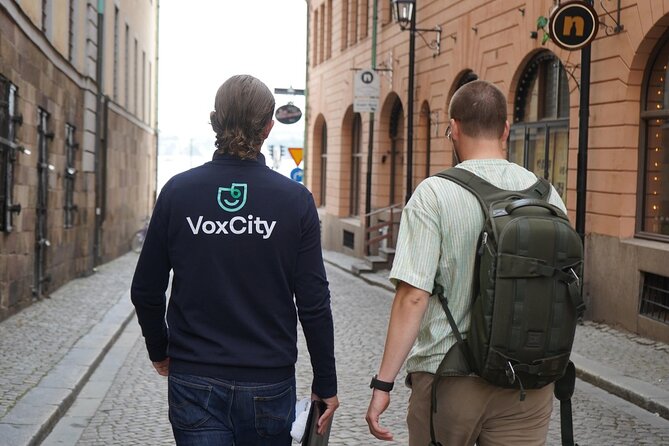
Gamla Stan can overwhelm you fast. Every corner looks historic, every street feels old, and every building looks important.
A 2-hour format helps because it gives you a mental map. You learn the key names and themes, like Gustav III, Birger Jarl, the Swedish Parliament era, and the Nobel connection, so later, when you pass a building on your own, it makes sense.
At the same time, this is not a full day with museum tickets. It works best as an orientation and story foundation, then you choose what to enter on your own with your newfound context.
Stop-by-stop: the story chain you’ll walk through
Other old-town lanes we walked and wrote up
Gustav III’s opera stage and the assassination shadow
You begin with the National stage for Swedish opera and ballet, founded in the 18th century by King Gustav III. The building you see now was given as a gift from King Oscar II, and the site carries the famous shadow of the assassination of Gustav III in 1792.
Why this stop is smart: it anchors the walk in a turning point. If you remember only one theme from this area, remember the way politics, culture, and violence intersect in Stockholm’s older layers.
Practical tip: keep an eye out for the lavish interior reputation, even if you are seeing the exterior only. It makes the later discussion of power buildings feel more grounded.
A square for Gustav II Adolf, plus the Vasa ship connection
Next is a square named for King Gustav II Adolf, the Lion of the North. The guide connects him to Swedish military power in the 17th century, including his role in commissioning the ill-fated Vasa ship.
This is the kind of historical thread that pays off later. Stockholm is full of sites that look gorgeous, but not all of them are peaceful. Learning one major link to shipbuilding makes the city’s maritime identity click.
Swedish Parliament building, built for modern power with older layers underneath
Then you reach the Swedish Parliament building, constructed from 1895 to 1904. The walk also points out the underground passage to the Assembly Hall, plus the Medieval Museum located beneath the bridge.
This stop helps you understand that Stockholm did not stop evolving in the Middle Ages. You are standing on modern governance space, but with layers that acknowledge what came before.
If you like architecture, this is a good moment to slow down and look at how the bridge, museum space, and political center relate.
The old royal residence story, reconstructed after fire
You move into a royal residence zone that dates back to the 13th century, then was reconstructed after a fire in the 17th century. It served as the royal residence until the current king moved to Drottningholm Castle.
Even if you do not tour inside, the guide’s timing helps you see the “why” behind changes. Stockholm’s buildings often reflect rebuilding after major events, and this stop is a clear example.
Gamla Stan’s medieval lanes and the defensive wall line
Now you are in the thick of Gamla Stan, where the area has been inhabited for over a thousand years. You walk along medieval streets, including Västerlånggatan, described as tracing the old defensive wall.
Why it matters: this is where you can feel the city’s logic. The guide points out how streets and walls shaped movement, safety, and the flow of everyday life.
Practical note: cobblestones plus walking time means good shoes matter. You do not need hiking boots, but you do want something with grip.
Sweden’s Supreme Court building and the highest court in the country
Next comes a former private residence now used as Sweden’s Supreme Court, the highest court of appeal in the country. The transition from home to courtroom is part of the story here, showing how prestige spaces get repurposed over time.
This is a good stop for anyone who likes how legal history sits inside everyday city architecture.
A 17th-century nobility building with a darker association
You then see a building built in the 17th century that once served Swedish nobility and is now used for events. The guide also ties it to the dark history connected to the assassination of Gustav III.
This is where the walk balances “pretty streets” with “real consequences.” It helps you understand why Stockholm’s Old Town is never just charming.
If you prefer light travel, you might find the political murders a lot. But the guide context helps it feel like part of one coherent historical arc, not random gloom.
Riddarholm Church, one of the oldest and monarch burial ground
Riddarholm Church is next. It is described as one of Stockholm’s oldest buildings and the burial site for Swedish monarchs.
This is a natural pause point because churches in Old Town areas often have a gravity that makes the rest of the walk sink in. Even if you only see the outside, you get the sense of the city’s long continuity.
Birger Jarl Square and the Svea Hovrätt connection
You move through Birger Jarl Square, named after Birger Jarl who first mentioned Stockholm in 1252. The guide connects him to early city identity, and points out the Svea Hovrätt, Sweden’s High Court, at the location.
This stop does two jobs. It anchors the city’s origin timeline and it links medieval beginnings to institutions that still shape modern life.
A photo moment at Evert Taube and a break from heavy dates
Then comes something more playful: the area includes a statue of Evert Taube, a famous Swedish author and musician, and it is called out as a great spot for photos.
This is a smart pacing move. After long stretches of dates and rulers, you get a visual landmark with a different emotional tone.
The Nobel trail: City Hall crowns, Blue Hall, and literature at the Swedish Academy
Nobel Banquet area and City Hall’s three golden crowns
The walk reaches the Nobel Banquet area, known for its stunning Blue Hall. The route also notes that Stockholm City Hall is marked by three golden crowns, a reminder of the Castle of Three Crowns.
This is where Stockholm’s modern global image meets Old Town geography. You can stand in a place connected to Nobel ceremonies and still feel the city’s older bones around it.
If Nobel interests you, this is one of the most memorable stretches. If it does not, it still gives you a strong story anchor so the walk does not only feel like a list of medieval facts.
The Great Fire of 1625, then jazz bars and boutiques
Next is an area tied to the Great Fire of 1625, and the walk shifts to the living side of the neighborhood. The route points out jazz bars like Stampen and boutique shops, showing that Old Town traditions keep turning into new uses.
This is a good reminder that historical areas survive by staying useful. Stockholm’s Old Town still serves people today, not just postcards.
Oldest streets, witch trial ghosts, and the Gray Man folklore
You then move onto one of Stockholm’s oldest streets, with a dark history tied to witch trials and ghosts, including the “Gray Man.” This is one of those stops where the guide’s storytelling tone can make a big difference.
Why this works on a walking tour: the street itself becomes the stage. You are not reading about fear centuries later, you are walking the lanes that carried those stories.
Oldest square and the Stockholm Bloodbath backdrop
The next big scene is the oldest square in Stockholm, connected to the Stockholm Bloodbath of 1520. You also hear about a cannonball embedded in a building that symbolizes the siege of 1521.
This is intense history. The guide’s job is to give you the context so it does not feel like random tragedy. If you handle dark stories well, this is a high-impact stop.
Practical tip: this is a good place to pause and take a slower look around. Your brain needs a moment to absorb what you just learned.
Swedish Academy and the Nobel Prize in Literature connection
You reach the Swedish Academy, which oversees the Nobel Prize in Literature. The walk also notes the Nobel Museum and Alfred Nobel’s legacy.
Even if you skip museum entry, the walk helps you understand why literature belongs in the Nobel spotlight and why Stockholm has built so much recognition around Nobel connections.
If you want to go inside later, this stop gives you the reason for it. If you do not, you still gain a clear mental map of what to look for next.
Gustav III’s obelisk and Karl XIV Johan’s statue for a final royal frame
You finish with an obelisk dedicated by King Gustav III and a statue of Karl XIV Johan, a French general who became the Swedish king. This final segment keeps the royal theme tight, so the walk ends with a strong visual and historical closure.
It is a satisfying way to wrap up the story arc: rulers, institutions, cultural landmarks, and the long shadow of pivotal events.
Value for money: why this tour works for both first-timers and repeat visitors
At $34.70 per person for about 2 hours, the best value comes from combining two layers. First, you get live guidance in English with a route through the Old Town’s best story sites. Second, the Vox City app extends the day with 5 self-guided tours and 125 points of interest.
That matters if you want a practical result from your time. You are not paying only for a walk, you are paying for a guided framework plus a digital plan you can use elsewhere.
The main trade-off is also simple: entry to attractions is not included. If your idea of travel is museum-heavy, you may feel like you are only skimming the surface. But if you want context, street-level understanding, and a map for choosing what to do next, this is strong value.
Who should book, and who might skip
This tour is especially good if you:
- want a fast Old Town orientation without committing to multiple ticketed stops
- like history tied to named places, not vague eras
- want Nobel-related context without spending your day on museum lines
- enjoy folklore stories, including the Gray Man thread
You might consider skipping or shortening your expectations if:
- you want lots of indoor time, since entry is not included
- you dislike walking on cobblestones
- you already know Gamla Stan well and prefer a museum-focused day
Quick FAQ for planning your walk
FAQ
How long is the Old Town and City guided walking tour?
It is approximately 2 hours.
Where does the tour start?
It starts at the pier below Slottsbacken, in front of the Gustav III statue at Skeppsbrokajen, 111 30 Stockholm.
Where does the tour end?
The tour ends back at the meeting point.
What languages are offered for commentary?
There is live commentary in English. The Vox City app also offers audio commentary in English, Italian, French, Spanish, and German.
Is public transportation included?
No. A public transportation ticket is not included.
Do I need my own phone or headset?
Yes. A mobile device and headset are not included.
Are attraction tickets included?
No. Entry to attractions is not included.
How large is the group?
The tour has a maximum of 99 travelers.
Is there free cancellation?
Yes. You can cancel for a full refund up to 24 hours before the experience’s start time.
Should you book this tour?
I’d book it if you want a high-efficiency way to understand Gamla Stan, connect Gustav III, the courts, and the Nobel story into one walk, and leave with a tool for exploring more of Stockholm. The live English commentary plus the Vox City app add-on is a good match for travelers who like structure but still want flexibility.
If you are chasing only indoor experiences, or you have a very specific must-see museum list, you may want to pair this with separate tickets. But for most people arriving with limited time, this is an easy, story-rich way to get your bearings and start seeing Stockholm with clearer eyes.
Reviewed Across Sweden





More Old Town Lanes




Stockholm, A Few More Ways
Other Swedish trips from the review pile
- ROYAL Castle Skokloster and Viking Sigtuna (private tour)
★ 4.5 · 3 reviews - Stockholm Port to Stockholm Arlanda Airport (ARN) – Departure Private Transfer
★ 3.5 · 3 reviews - Stockholm Ghost Hunt: Self-Guided Tour and Puzzle Adventure
★ 4.5 · 3 reviews - Private Photography workshop in Stockholm
★ 5.0 · 3 reviews - Private blood, ghosts and folklore Old Town 2h Stockholm tour
★ 4.0 · 3 reviews - Ghosts of Stockholm: A Guided Tour of Horror and Dark Folklore
★ 4.5 · 3 reviews
Gamla Stan & Old Town Walks, compared.
 ★ 5.0Walking Tour of Stockholm Old TownFrom $241,175 reviews
 ★ 4.5The Original Stockholm Ghost Walk and Historical Tour – Gamla StanFrom $381,165 reviews
 ★ 5.0Walking Tour of Stockholm’s Old Town, Gamla StanFrom $13451 reviews
 ★ 4.9Old Town Historical Walking TourFrom $52344 reviews
 ★ 4.0Old Town Tour of StockholmFrom $51289 reviews
 ★ 4.7Old Town Guided Walking Tour (English / Deutsch)From $29284 reviews
 ★ 4.7Secrets of Gamla Stan Guided Tour w/ Fika OptionFrom $16282 reviews
 ★ 4.8Old Town Walking Tour, stories and secretsFrom $16275 reviews
Browse the lists this tour appears in